Structural Issues in Old Knoxville Homes: What Your Crawl Space Is Telling You
What I Found Under This Old Knoxville House
CEDAR POSTS, HAND-DUG LIMESTONE, AND A LOT OF HARD WORK AHEAD
I'm out in Knoxville today looking at an old house with sagging floors.
And when I say old, I mean old - this crawl space was hand-dug out of solid limestone, probably 80 or 100 years ago.
The homeowner's noticing what everyone notices when their crawl space has structural problems - floors that feel soft or bouncy when you walk across them, maybe some sagging in certain spots.
So they called us out to take a look. And yeah, there's a lot going on down here.
Original cedar posts holding up the main beam. Some supplemental jacks that somebody added at some point.
Extra wood supports patched in where things were settling. Fungal growth everywhere. Insulation falling down throughout the entire space.
Plus, the access is brutal. I had to belly crawl through tight spaces and squeeze between floor joists just to get to the one area where I could stand up. Then belly crawl back out.
This is going to be a tough job. But let me walk you through what we're actually dealing with and what it's going to take to get this house settled and secure.
How Old Houses Were Built
Back when this house was built, they did things differently. They didn't have the materials or equipment we have today, so they worked with what they had.
Cedar was the wood of choice for foundation support. Why? Because it resists rot better than most other woods. If you're going to put wooden posts under a house where moisture is always going to be an issue, cedar's your best bet for longevity.
And that crawl space? Somebody dug that out by hand. I'm talking pick and shovel, chipping away at solid limestone, probably for weeks. No excavators. No jackhammers. Just backbreaking work to create a foundation space under the house.
When you look at it that way, you've got to respect the effort. These weren't shortcuts - this was serious craftsmanship with the tools they had available.
But here's the reality - even cedar posts don't last forever. And foundations settle over time, especially when you're dealing with hand-dug limestone and the natural shifting that happens over decades. The house has been standing for close to a century, and now it needs help.
The Structural Problems I'm Seeing
So what's actually going wrong under this house?
First, there are supplemental jacks down here. That tells me someone already knew there was a settling problem and tried to address it. When you see jacks added to an old crawl space, it means the original support system wasn't cutting it anymore.
Then there are extra wood supports patched in at various spots. Again, that's someone trying to shore things up as problems developed over the years.
The original cedar posts are still there, and honestly, some of them are still doing their job. But cedar or not, wood sitting in a damp crawl space for 80-plus years is going to deteriorate eventually. Some of these posts aren't providing the support they used to.
When all of this starts failing, that's when you feel it upstairs. Floors that bounce when you walk on them. Sagging in certain rooms. Gaps appearing between your floor and baseboards. That's your house telling you the support underneath isn't holding things level anymore.
But Structure Isn't the Only Problem
Here's what a lot of homeowners don't realize - when your crawl space has structural issues, you've almost always got moisture issues too.
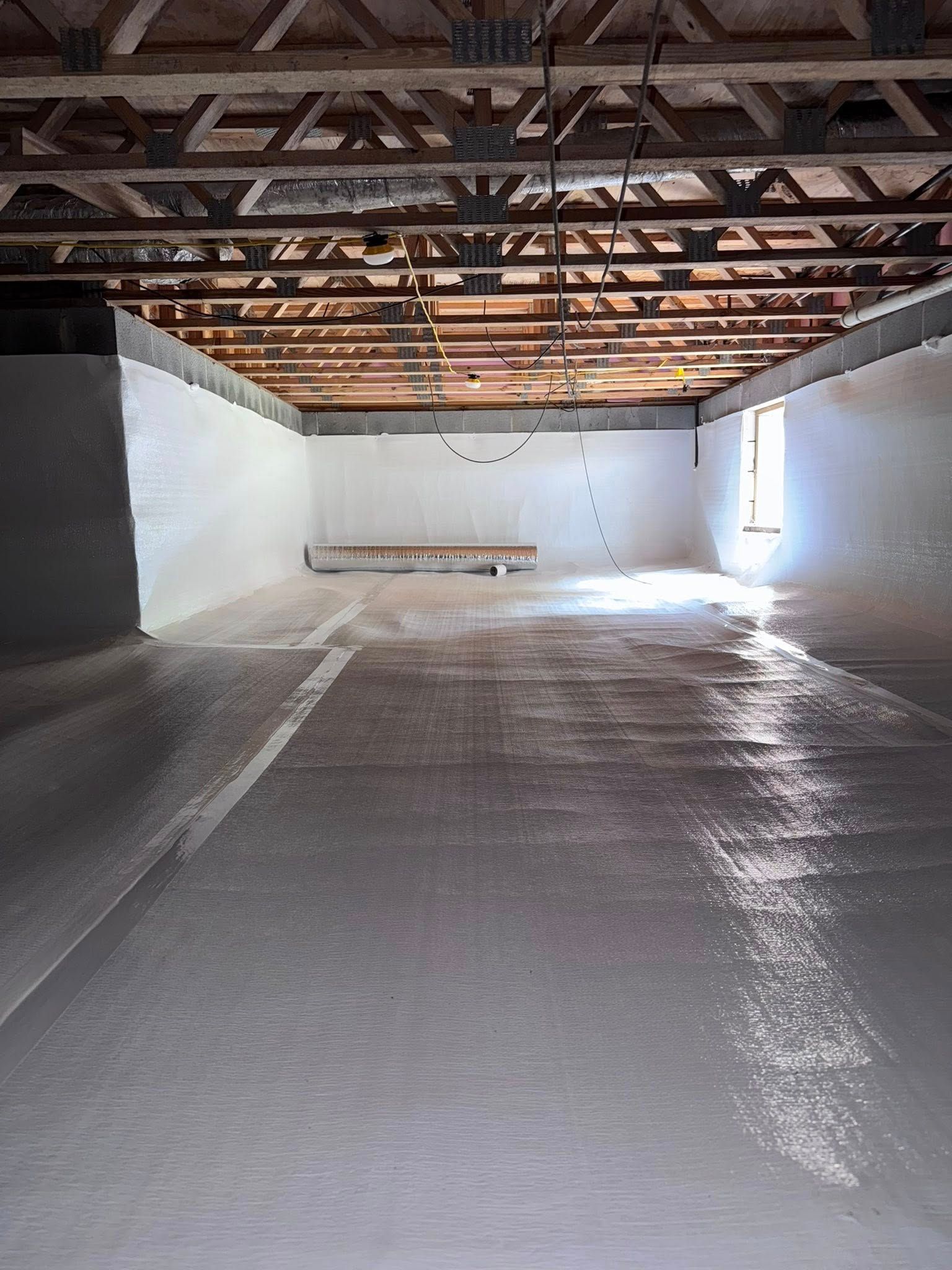
This crawl space has fungal growth all over the place. On the wood supports, on the floor joists, on the subfloor above. That's happening because there's too much moisture down here, and it's been that way for a long time.
The insulation is falling down throughout the entire space. Once insulation gets saturated with moisture, it gets heavy and pulls away from the subfloor. Then it's just hanging there useless, or lying in piles on the ground.
And here's the thing - you can't just fix the structural problems and ignore the moisture. If we come in here and install new support beams and jacks but don't address the fungal growth and moisture control, we're just putting new structure in a bad environment. It's going to deteriorate faster than it should.
So when we're talking about fixing an old house crawl space, we're talking about structure AND moisture. Both have to be addressed, or you're not really solving the problem.
The Access Challenge
Now let me talk about something that really affects how we approach this job - access.
This crawl space is tight. I had to get down on my belly and crawl through spaces between the floor joists just to move around. There's one small area in the middle where I can actually stand up. The rest of it? Belly crawling the whole way.
That matters because when we're trying to bring in new support beams, install jacks, remove old insulation, and treat for fungal growth, we have to physically get all that material and equipment through those tight spaces.
Every beam has to be maneuvered through. Every jack has to be carried in on our bellies. Every bag of old insulation has to be dragged back out the same way we came in.
It's not impossible, but it's slow, it's hard on the crew, and honestly, it affects the cost. The tighter the access, the more labor hours it takes to do the same work.
So sometimes we have to look at whether there's a better way to approach it..
What Knoxville Homeowners with Old Houses Should Know
If you've got an old house in Knoxville, here's what you need to watch for.
Sagging or bouncy floors are the biggest sign something's wrong underneath. If you're walking across your living room and the floor feels soft or springy, that's settling or failing support.
Gaps between your floor and baseboards, doors that suddenly don't close right, cracks appearing in plaster or drywall - those are all symptoms of a house that's shifting because the foundation support isn't holding things level anymore.
Old houses settle differently than new construction. Modern houses are built on concrete foundations with engineered floor systems. Old houses like this one? They're sitting on cedar posts and hand-dug stone. It's a completely different system, and it needs to be treated differently.
When you're talking to contractors about fixing it, ask them: Are they addressing just the structure, or are they also handling the moisture and fungal growth? Are they planning to work from the crawl space, or is subfloor access on the table? What's the realistic timeline and cost?
And be ready for honest answers. Fixing an old house right isn't always quick or cheap. But it's worth doing it properly so it lasts another 80 years.
Ready to Get Your Old House the Help It Needs?
If your floors are sagging, if you're noticing settling, or if you just want to know what's actually going on under your old house, give us a call.
We'll come out and do a free inspection. I'll crawl through your space, take pictures of everything, and give you an honest assessment of what needs to happen.
No pressure. No games. Just a straightforward conversation about your house and what it's going to take to make it right.
You can reach out to me directly - I'm the owner, and I'll probably be the one doing your inspection. We'll get you on the schedule and figure out the best plan for your specific situation.
Old houses have character. Let's make sure they've got the support to match.
Contact Forever Guard Waterproofing today for your free crawl space inspection.